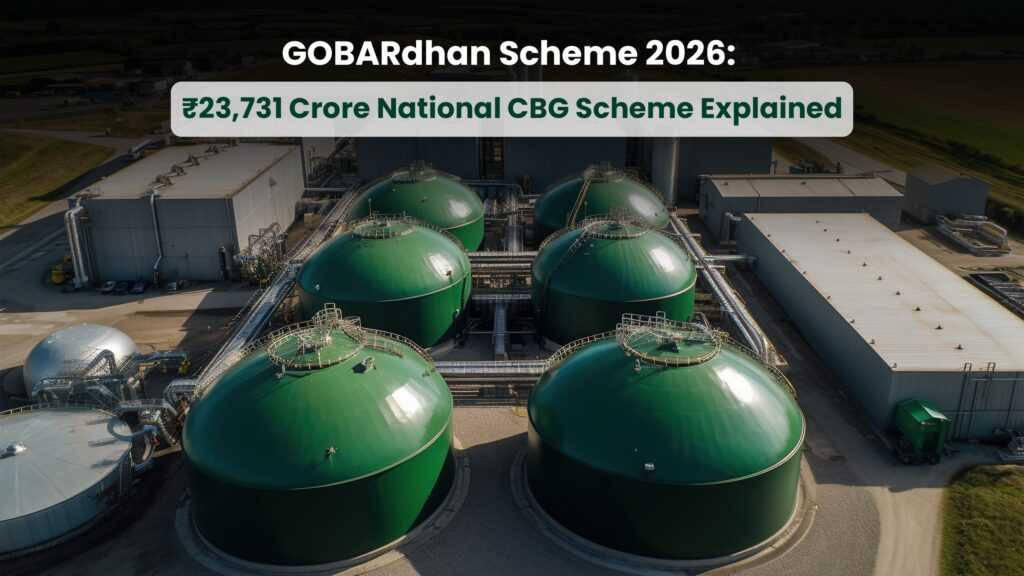
GOBARdhan Scheme 2026: ₹23,731 Crore National CBG Scheme Explained
The GOBARdhan Scheme 2026 is a Government of India initiative approved by the Union Cabinet with a total outlay of ₹23,731 crore to promote Compressed Biogas (CBG) production nationwide. It offers capital assistance of up to ₹2 crore per TPD (tonne per day) of installed CBG capacity, an assured offtake mechanism through City Gas Distribution entities, and a 10-year fixed price of ₹2,110 per MMBTU. The scheme targets entrepreneurs, waste management companies, dairy/agri businesses, and existing CBG operators looking to expand.
What Is the GOBARdhan Scheme?
GOBARdhan stands for Galvanizing Organic Bio-Agro Resources Dhan. It converts organic waste, cattle dung, agricultural residue, and other biodegradable material into Compressed Biogas (CBG), biogas, organic manure, and bio-fertilizers.
First launched in 2018 under the Swachh Bharat Mission (Grameen), the scheme was expanded in 2026 into a National Unified Scheme, consolidating support across ministries under a single, larger framework focused specifically on CBG infrastructure and production.
Key Features at a Glance
|
Feature |
Detail |
|
Total Scheme Outlay |
₹23,731 crore |
|
Capital Assistance |
Up to ₹2 crore per TPD of installed CBG capacity |
|
Eligible Projects |
Greenfield and brownfield (expansion) CBG projects |
|
Assured Offtake |
Via City Gas Distribution (CGD) entities |
|
CBG Blending Mandate |
3% (2026–27) → 4% (2027–28) → 5% (2028–29 onwards) |
|
Fixed CBG Price |
₹2,110 per MMBTU |
|
Price Assurance Period |
10 years |
|
Additional Support |
Feedstock aggregation, manure processing, pipeline infrastructure |
Capital Assistance: How Much Can a Project Receive?
Eligible greenfield CBG projects can receive capital assistance of up to ₹2 crore per tonne per day (TPD) of installed capacity.
Example: A project with an eligible installed capacity of 10 TPD could potentially qualify for capital assistance of up to ₹20 crore, subject to scheme conditions, eligibility criteria, and the approval process.
Support extends beyond core plant machinery to:
- Feedstock aggregation infrastructure
- Organic manure processing
- Value-addition equipment
Brownfield projects, i.e., existing CBG plants expanding capacity, are also eligible.
Assured Offtake and Pricing Framework
Two of the biggest risks for any CBG developer are where I will sell the gas and at what price. The 2026 scheme addresses both directly:
Assured Offtake: City Gas Distribution (CGD) entities are mandated to blend CBG into CNG and household PNG supply, with blending targets rising from 3% (2026–27) to 5% (2028–29 onwards).
Fixed Pricing: The government has set an administered price of ₹2,110 per MMBTU, backed by a 10-year revenue assurance framework that provides developers with long-term visibility for financial planning.
Who Can Benefit From the GOBARdhan Scheme?
- CBG project developers (new and expanding)
- Waste management companies
- Agricultural entrepreneurs
- Dairy and livestock businesses
- Biomass aggregators
- Renewable energy companies
- Existing CBG plant operators
- Organic manure and bio-fertilizer producers
- Green-energy investors
If you’re planning a CBG project in Gujarat specifically, it’s worth reviewing how this national scheme stacks with state-level CBG subsidies and incentives in Gujarat, which can significantly increase total project support.
Before You Apply: 7 Things to Check First
Government support doesn’t automatically make a CBG project financially viable. Before investing, entrepreneurs should complete a feasibility study covering:
- Feedstock availability: is supply consistent year-round?
- Land & location: proximity to feedstock sources and target market
- Right-sized capacity: based on actual feedstock volume, not just subsidy eligibility
- Full project cost: land, civil works, machinery, storage, compression, pipeline connectivity, working capital
- Revenue projections: CBG sales, organic manure, and other by-products
- Regulatory approvals: environmental, pollution-control, land-use, and safety clearances
- A bankable DPR: covering project cost, means of finance, revenue, operating costs, and debt servicing
Conclusion
The GOBARdhan Scheme 2026 goes beyond a subsidy program; it’s an attempt to build an integrated ecosystem around waste management, renewable energy, and organic manure production. With ₹23,731 crore in outlay, capital assistance, assured offtake, fixed pricing, and infrastructure support, it gives CBG entrepreneurs a stronger foundation to plan around.
That said, every project still needs individual evaluation: a feasibility study, a realistic financial model, feedstock assessment, and a bankable DPR before applying for financing.
At SDS Fin Advisory LLP, we help CBG entrepreneurs structure bankable DPRs and project finance applications. Planning a CBG project? Talk to our project finance team.
Frequently Asked Questions
What is the total outlay of the GOBARdhan Scheme 2026?
The Union Cabinet approved a total outlay of ₹23,731 crore for the National Unified GOBARdhan Scheme.
How much capital assistance can a CBG project get?
Eligible greenfield CBG projects can receive up to ₹2 crore per TPD of installed capacity, extending to feedstock aggregation and manure processing infrastructure.
Are expansion (brownfield) CBG projects eligible?
Yes. Brownfield projects expanding existing CBG production capacity are eligible under the 2026 framework, in addition to new greenfield projects.
What is the fixed price for CBG under this scheme?
₹2,110 per MMBTU, backed by a 10-year government revenue assurance framework.
What are the CBG blending targets?
3% in 2026–27, rising to 4% in 2027–28, and 5% from 2028–29 onwards, applicable to CNG (transport) and household PNG.
Do I need a Detailed Project Report (DPR) to apply?
Yes. A bankable DPR covering project cost, means of finance, revenue projections, operating costs, and debt servicing is essential before financial closure and loan/subsidy application.