
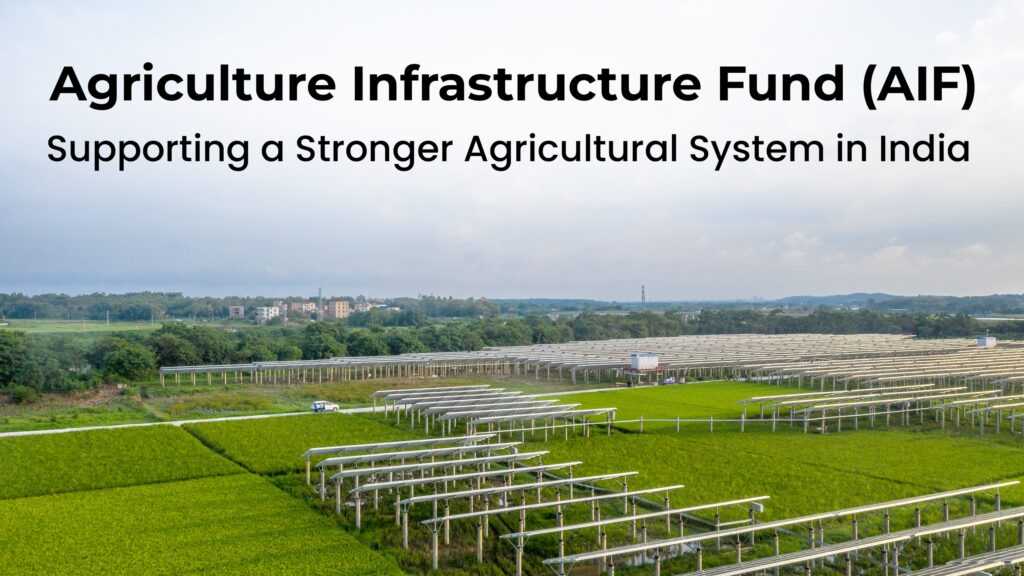
Agriculture Infrastructure Fund (AIF): Supporting a Stronger Agricultural System in India
Over the last several years, Indian agriculture has witnessed noticeable progress. Crop productivity has improved, modern farming methods are being adopted, and technology is gradually reaching rural regions. However, in spite of these developments, farmer income often remains under pressure. The main reason lies beyond cultivation — it lies in what happens once harvesting is complete.
Across many agricultural belts, farmers are left with little choice but to sell their produce immediately. Limited availability of storage, lack of processing options, and weak access to organised markets compel quick sales, frequently at low prices. As a result, produce wastage and income loss become recurring issues. To correct this long-standing imbalance, the Agriculture Infrastructure Fund (AIF) was introduced, with the objective of strengthening post-harvest and community-based infrastructure through accessible long-term financing.
A Closer Look at the Agriculture Infrastructure Fund
The Agriculture Infrastructure Fund (AIF) Scheme functions as a financing-enabling initiative that encourages investment in agriculture-related infrastructure. Instead of depending entirely on grants, it improves the viability of projects by reducing the financial burden associated with loans used for infrastructure creation.
The intent behind AIF is to make facilities such as storage units, processing centres, logistics systems, and shared farming assets economically feasible at the farm level. When such facilities are available locally, farmers and rural enterprises gain greater flexibility in deciding how and when their produce enters the market.
Farmers, agri-startups, and rural entrepreneurs can access detailed guidelines, eligibility criteria, and application procedures through the official Agriculture Infrastructure Fund portal.
Why Strengthening Infrastructure Is Essential
One of the most persistent weaknesses in Indian agriculture is the absence of organised post-harvest arrangements. Without reliable systems for storage and movement, farmers experience losses during handling and transportation and remain dependent on intermediaries for market access.
AIF addresses this structural issue by promoting infrastructure that improves product quality, reduces wastage, and expands market reach. This enables farmers to avoid forced selling, while rural businesses benefit from new service opportunities, job creation, and more efficient supply networks within agricultural regions.
Financial Support Available Through AIF
A key advantage of the Agriculture Infrastructure Fund is its financing structure, which eases repayment pressure for borrowers while also reducing lending risk.
Projects approved under AIF are eligible for:
- Interest relief of up to 3% annually on loan amounts not exceeding ₹2 crore.
- An interest benefit applicable for a period of up to seven years.
- Credit guarantee coverage for loans up to ₹2 crore, helping reduce collateral demands.
- Repayment flexibility, including a moratorium period to support projects during initial operations.
Together, these features make capital-intensive agriculture infrastructure projects easier to sustain in their early stages.
In many cases, businesses developing agricultural infrastructure also explore MSME loan assistance to manage project financing alongside government schemes.
Infrastructure Categories Eligible Under AIF
The fund supports a wide spectrum of agriculture and allied infrastructure, such as:
- Storage and warehousing facilities.
- Cold storage and temperature-controlled supply chains.
- Grading, sorting, and packaging units.
- Basic processing facilities.
- Transport and logistics solutions, including refrigerated vehicles.
- Quality assessment and assaying infrastructure.
In addition, the scheme also encourages the development of shared farming assets, including:
- Farm equipment hiring centres.
- Seed and planting material processing facilities.
- Organic input and bio-resource production units.
- Precision agriculture tools and digital farming solutions.
Priority is given to projects that serve groups of farmers or entire production clusters.
Eligible Applicants Under the Scheme
AIF has been designed to accommodate a broad range of stakeholders involved in agriculture and allied activities. Eligible participants include:
- Individual farmers.
- Farmer-Producer Organizations (FPOs).
- Primary Agricultural Credit Societies (PACS).
- Cooperatives and self-help groups.
- Agri-startups and rural entrepreneurs.
- Government-backed and PPP-based agriculture initiatives.
This broad eligibility ensures that infrastructure creation is not limited to large players alone.
Combining AIF With Other Government Schemes
The Agriculture Infrastructure Fund allows projects to be structured alongside other central or state government incentive programs. When capital subsidy support is available under another scheme, it can be counted toward the promoter’s contribution, thereby lowering upfront investment and improving overall project feasibility.
On-Ground Impact of AIF
At the operational level, AIF brings visible change. Access to storage and processing facilities reduces the urgency to sell immediately after harvest. Improved handling enhances produce quality, losses are minimised, and farmers gain stronger negotiating positions in the market.
Moreover, infrastructure development within rural areas generates local employment and supports value addition closer to production centres, contributing to stronger village economies and reduced migration pressures.
Our Role in Supporting AIF Projects
Understanding scheme guidelines, preparing documentation, and coordinating with banks can be challenging for applicants. Professional guidance helps ensure smoother execution and better approval outcomes.
Our assistance includes:
- Assessing project feasibility.
- Preparing Detailed Project Reports (DPRs).
- Structuring loans and interest benefits.
- Coordinating with financial institutions and authorities.
- Providing complete end-to-end support throughout the application process.
This ensures projects remain compliant, viable, and bankable.
Conclusion
The Agriculture Infrastructure Fund is a long-term initiative aimed at improving agricultural infrastructure and creating sustainable growth opportunities in rural India. By enabling better storage, processing, and logistics networks, the scheme supports higher farmer income and more efficient agricultural supply chains.
If you are planning to set up an agriculture infrastructure project and need assistance with financing or documentation, SDS Fin Advisory LLP can help with expert consultation, DPR preparation, and complete support for AIF loan applications.
Frequently Asked Questions
Is the Agriculture Infrastructure Fund a grant or a loan scheme?
AIF is a loan-oriented scheme supported by interest relief and credit guarantee provisions.
What is the maximum loan amount eligible for interest benefit?
Loans up to ₹2 crore per project are eligible for interest support.
Is collateral mandatory under AIF?
Collateral requirements may be reduced through credit guarantee coverage, depending on lender norms.
Can small farmers benefit from AIF?
Yes, particularly when they participate through FPOs, cooperatives, or shared infrastructure models.
Are processing facilities eligible under AIF?
Yes, primary processing and post-harvest infrastructure are covered.