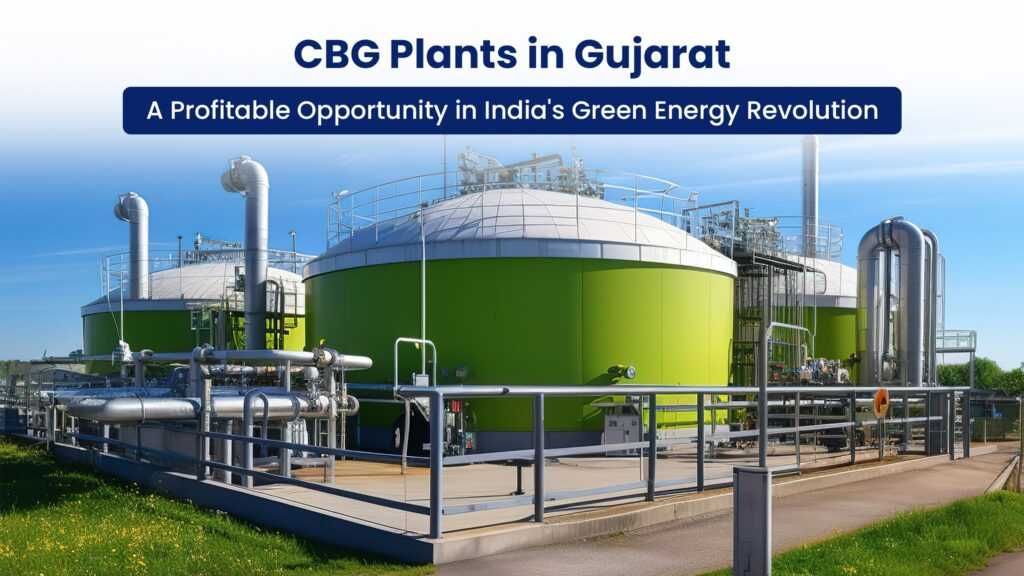
CBG Plants in Gujarat: A Profitable Opportunity in India’s Green Energy Revolution
Waste Today, Energy Tomorrow
Every year, thousands of tons of agricultural residue, organic waste, and biodegradable materials are generated across Gujarat. While much of this waste has traditionally been treated as a disposal problem, modern bio-energy technologies are transforming it into a valuable resource.
Compressed Biogas (CBG) has emerged as one of the most promising solutions in this space. By converting organic waste into clean, renewable fuel, CBG plants not only address environmental concerns but also create sustainable business opportunities for investors and entrepreneurs.
To accelerate investments in CBG Plants in Gujarat, the Government of Gujarat has introduced a range of financial incentives designed to make CBG projects more commercially viable and attractive.
What Is Compressed Biogas (CBG) and Why Does It Matter?
CBG is produced by processing organic waste — agricultural residue, cattle dung, food waste, sewage sludge — through anaerobic digestion. The output is a clean, renewable fuel comparable to CNG, used in transportation, industrial heating, and commercial applications.
Unlike solar or wind energy, CBG production is not weather-dependent. As long as feedstock is available — and in Gujarat, it consistently is — a CBG plant can produce fuel year-round.
A secondary output, fermented organic manure (FOM), creates an additional revenue stream for plant operators, further improving project economics.
What Makes CBG an Attractive Business?
Unlike many renewable energy projects that depend on weather conditions, CBG production relies on readily available organic feedstock. Agricultural waste, cattle dung, food-processing residues, municipal organic waste, and other biodegradable materials can all be used to generate gas.
The growing demand for cleaner fuels in transportation, industrial applications, and commercial establishments has further strengthened the market for CBG. Additionally, the organic manure produced during the process can create an additional source of revenue for plant operators.
As industries increasingly focus on sustainability and carbon reduction, the long-term outlook for the CBG sector remains highly positive.
Gujarat’s Push Towards Biofuel Development
Gujarat has established itself as one of India’s leading industrial states. Recognizing the importance of renewable energy and waste management, the state government has introduced supportive policies aimed at encouraging investment in biofuel manufacturing.
These initiatives are intended to reduce project costs, improve financial feasibility, and encourage entrepreneurs to participate in the state’s clean energy transition.
Types of Subsidies Available for CBG Plants in Gujarat
The Government of Gujarat provides multiple incentives to encourage investment in CBG Plants in Gujarat. Depending on the project size and investment value, eligible units can avail capital support, operational assistance, interest subsidies, employment incentives, and other benefits.
| Type of Subsidy | CBG Plant (Investment below ₹200 Crore) | Mega CBG Project (Investment above ₹200 Crore) | Benefit Period / Disbursement |
| Capital Subsidy | 25% of the eligible fixed capital investment, up to ₹40 Crore | 25% of the eligible fixed capital investment, up to ₹200 Crore | Released over 5 years |
| Operational Assistance | 15% of operational expenditure, up to ₹5 Crore per year | 15% of operational expenditure, up to ₹25 Crore per year | As per approved claims |
| Employment Generation Incentive | Support linked to employee compensation | Support linked to employee compensation | Periodic reimbursement |
| EPF Assistance | Reimbursement of the eligible EPF contribution | Reimbursement of the eligible EPF contribution | Annual basis |
| Interest Subsidy | Interest support for eligible project loans | Interest support for eligible project loans | Up to 5 years from commissioning |
| Electricity Duty Exemption | 100% exemption | 100% exemption | Up to 5 years |
| Facilitation Support | Standard approval process | Dedicated government facilitation support | Throughout project implementation |
Note: Eligibility, claim procedures, and incentive amounts are subject to applicable government guidelines and approvals.
Financial Support Available for CBG Projects
Capital Investment Assistance
Setting up a CBG facility requires substantial investment in plant and machinery, infrastructure, processing equipment, and utilities. Government support towards eligible project investments helps reduce the overall capital burden and improves project viability.
Assistance on Loan Interest
Many entrepreneurs rely on term loans to finance large-scale projects. To reduce financing costs, eligible CBG units may receive support on interest payments, helping improve cash flow during the initial years of operation.
Operational Cost Benefits
Running a biofuel plant entails expenses for manpower, maintenance, utilities, and processing. Financial assistance tied to operational expenses can significantly improve profitability in the early stages of business operations.
Employment-Based Incentives
Projects that create local employment opportunities may qualify for additional benefits. These incentives encourage industries to generate jobs while contributing to regional economic development.
EPF Reimbursement Support
To promote formal employment and workforce participation, eligible projects may receive reimbursement benefits associated with employee provident fund contributions.
Electricity Duty Exemption
Energy expenses often form a major component of operational costs. Exemptions on electricity duty can provide meaningful savings and improve the financial performance of a CBG project.
Important Considerations Before Investing
Before initiating a project, investors should carefully evaluate:
- Availability of a consistent feedstock supply.
- Land and infrastructure requirements.
- Technology selection and plant capacity.
- Market demand for compressed biogas.
- Financial feasibility and return on investment.
- Applicable government incentives and compliance requirements.
A detailed project report (DPR) and proper financial planning are essential for securing approvals and maximizing available benefits.
Who Should Explore This Opportunity?
CBG projects can be suitable for:
- Farmers’ producer organizations (FPOs)
- Agro-processing industries
- Dairy businesses
- Waste management companies
- Renewable energy investors
- Industrial groups seeking alternative fuel solutions
- Entrepreneurs interested in sustainable infrastructure projects
Organizations with access to large volumes of organic waste may find CBG projects particularly attractive from both environmental and commercial perspectives.
General Process for Availing Government Incentives
While the exact procedure may vary depending on project size and applicable schemes, the process generally includes:
- Preliminary project planning and feasibility assessment.
- Preparation of technical and financial project reports.
- Submission of applications to relevant authorities.
- Review and verification of project details.
- Approval of eligible incentives.
- Periodic submission of claims and supporting documents.
- Release of approved financial assistance as per applicable guidelines.
Maintaining proper documentation and compliance records is critical throughout the process.
Long-Term Potential of the CBG Industry
The future of compressed biogas looks promising as India continues to focus on clean energy, waste-to-wealth initiatives, and sustainable industrial development. Increasing fuel demand, favorable government policies, and growing environmental awareness are expected to drive further growth in the sector.
For investors seeking opportunities in renewable energy with strong long-term potential, CBG projects offer a compelling combination of environmental impact and business profitability.
Final Thoughts
Gujarat’s supportive ecosystem and policy initiatives make it one of India’s most attractive destinations for CBG investment. With the right planning and feedstock strategy, a CBG plant can be both profitable and impactful. If you’re ready to take the first step, SDS Fin Advisory LLP can help you navigate the subsidies, secure financing, and turn your project into a reality.